Zoning Decides How Much House the Land Will Hold
Building on five acres outside Eaton is not a bigger version of building on a suburban lot in Mason. Different sequence, different offices, and a different set of things that can stop the project cold. Most of them get settled long before a foundation is poured, and most of them are workable if you see them coming. The ones below are where rural builds in Preble and Clinton County actually diverge.
On a platted suburban lot, the building envelope is usually obvious. On farm ground it is a question you have to ask, because the answer depends on which district the parcel sits in and how the land is served.
Preble County’s zoning resolution covers the unincorporated townships and sets minimums by district. Agricultural ground carries a forty-acre minimum lot area with three hundred feet of width. Restricted Rural Residential drops that to two acres, and a residential lot without central sewer generally needs at least an acre, with width and setbacks scaling along with it.
Clinton County works the same way with different numbers. A-1 agricultural land carries roughly a forty-one-acre minimum, A-2 is ten acres, A-3 is two. The figure most rural buyers actually need sits in the Rural Residential and Suburban Residential districts: a lot served by its own well and septic needs an acre and a half. Public water alone brings it down to an acre.
Eleven of Clinton County’s thirteen townships are zoned. Clark and Washington are not, which does not mean no permit. A building permit is required countywide either way. Clarksville, worth noting, sits in Vernon Township, which is zoned.
which district is this parcel in, and what is the minimum lot area for a home served by well and septic? A parcel can be plenty of land and still be the wrong shape or the wrong district.
The Farm Split Is Its Own Problem
A lot of rural land comes to market as a piece carved off a working farm. Ohio has a shortcut for that, and it has limits.
Under state law, dividing land into parcels larger than five acres, with no new streets or access easements, is not treated as a subdivision at all. Below that, or where a new access easement is involved, you are in the minor subdivision process. Ohio’s approval-without-plat path covers a division along an existing public street, with no new road, and no more than five lots out of the original tract. The planning authority is required to act within seven business days.
Seven business days sounds fast, and the clock is real. The catch is in the same statute: the division cannot be contrary to health, sanitary, or access management rules. In practice the health district’s read on the soil, not the surveyor’s drawing, is what decides whether the parcel is buildable.
Preble County adds its own constraint in the agricultural district. Only one farm homestead split may be made from a particular farm, and what is left behind has to remain a conforming agricultural tract. If the seller has already used that split, the deal you are looking at may not exist the way it was described.
CAUV Recoupment Is the Tax Surprise Nobody Mentions
Most farm ground in this part of Ohio is enrolled in Current Agricultural Use Value, which taxes land on its farming value rather than its market value. It costs real money to come out of, and it almost never comes up at the kitchen table. Clinton County is overwhelmingly agricultural: the 2022 USDA Census of Agriculture counted 788 farms and 241,315 acres in farms, which is most of the county’s land area.
When land comes out of CAUV, Ohio law levies a recoupment charge equal to the tax savings on the converted land for the three tax years before conversion. Building a house on it is a conversion. The part that catches buyers is who pays. The charge falls on the owner of record at the time the land is converted, even if that owner never received a dollar of the past savings. Buy a split-off parcel, build on it, and the bill can be yours.
There is nuance in how much of a parcel counts as converted, and it is not spelled out plainly anywhere public. Get the answer in writing from the county auditor before closing. Clinton County’s auditor is at 937-382-2250; Preble County has its own. This is also a reasonable question to put to a real estate attorney rather than to your builder.
Electric Service Runs on a Schedule You Do Not Control
On a suburban lot the power is at the curb. On rural ground it is a project with its own timeline, and it is frequently the thing that sets your start date.
Which utility serves the parcel depends on the address, not the county. Rural Preble County may be served by Darke Rural Electric, which covers Darke, Preble, and Mercer counties, or by Butler Rural Electric, which covers parts of Butler, Hamilton, Preble, and Montgomery. Clinton County is a different picture again. Confirm the serving utility by address before you assume anything.
The sequence is where the time goes. Butler Rural Electric’s published process for a new home starts with getting an address from the county tax map office and applying for membership, then has you mark your property lines and building location for an on-site meeting with an operations representative. A construction invoice follows within ten business days. You pay it, clear right-of-way if the rep says it is needed, and wait while the co-op runs primary line from the road to the transformer. Temporary service, inspection, energizing, permanent meter base, secondary line, final inspection, and permanent energizing all follow, several carrying their own ten-business-day window.
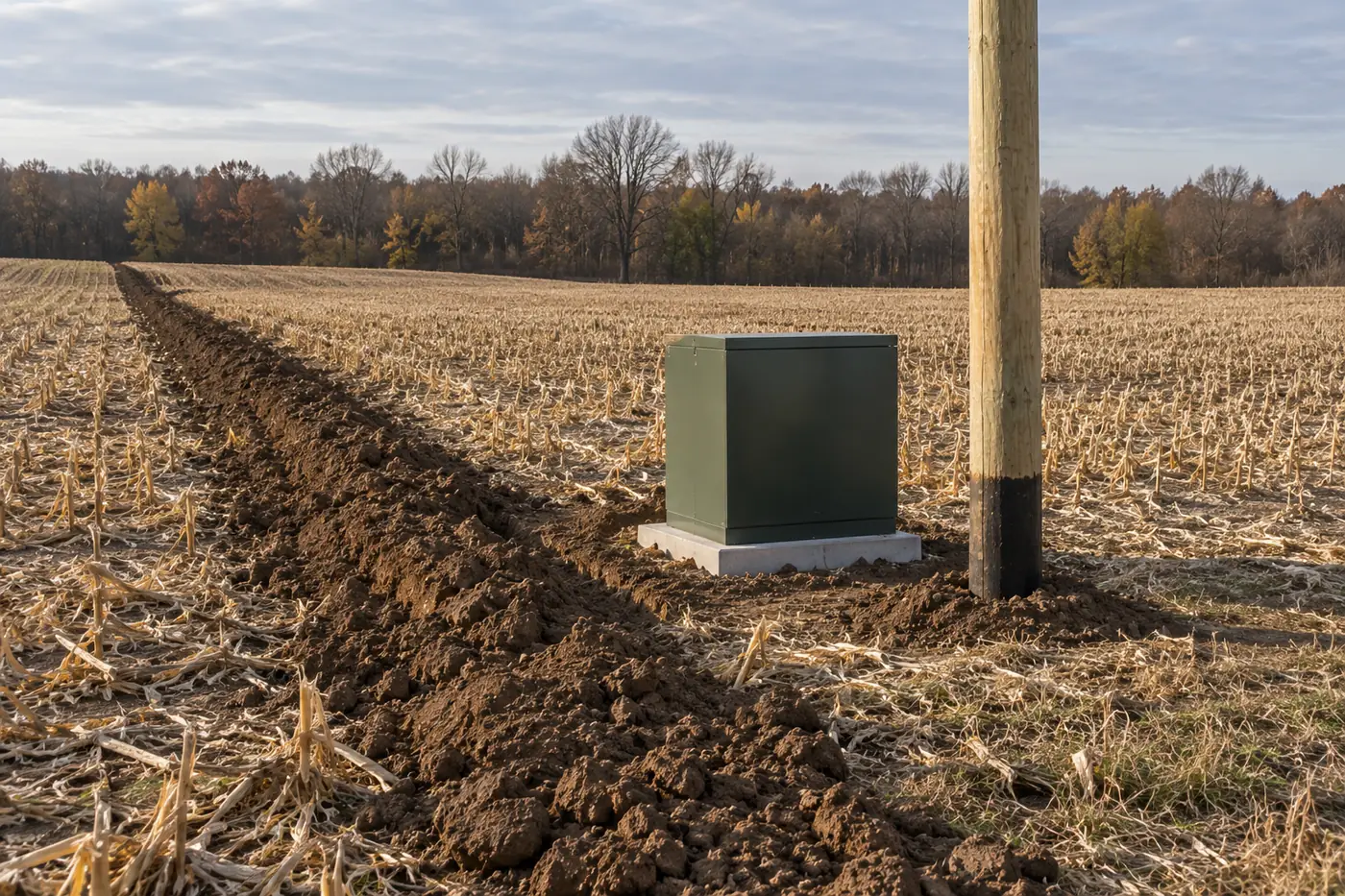
AES Ohio publishes a comparable picture for its territory: typically sixty to one hundred twenty days from receipt of a construction application, with construction starting three to four weeks after payment. The customer handles all trenching and backfilling, provides conduit anywhere the service crosses a road or driveway, and has to bring the site within six inches of final grade before the utility begins. Easements may be required.
None of that is unreasonable. All of it takes calendar time, and it runs alongside the build only if somebody started it early. It is also one of the cost components that suburban buyers never have to think about.
The Driveway Needs Its Own Permit
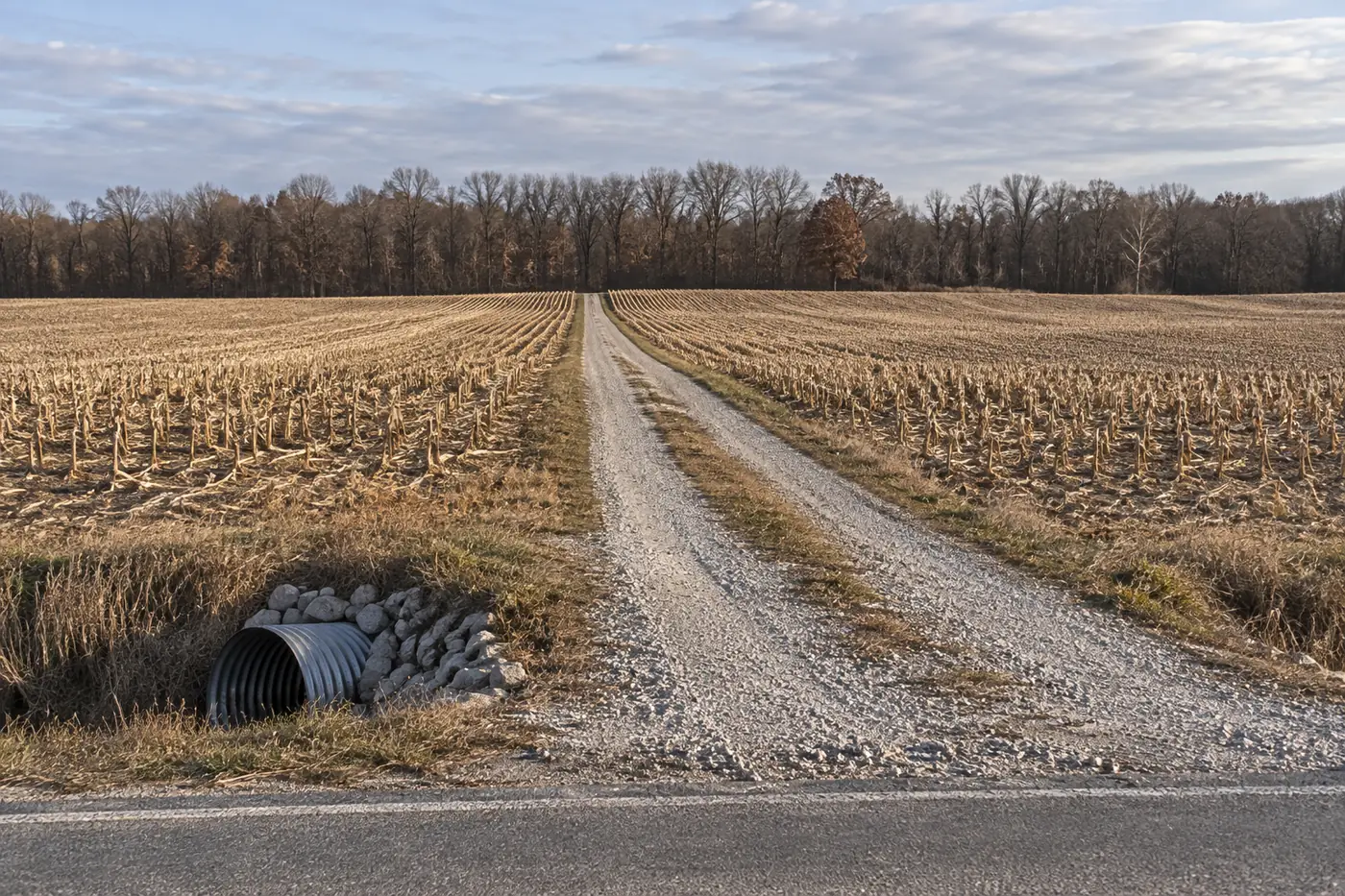
A long approach off a county road brings an access permit with it, and often a culvert permit on top of that.
Clinton County requires an access permit before a new residential driveway is built, issued by the County Engineer after evaluating the location for sight distance and safety, usually within about a week. If the driveway crosses a ditch along a county or township road, a culvert permit is required and the Engineer specifies the pipe size, length, and material. Authority is split by township: the Engineer’s office handles culverts in some, the township trustees in others. Culverts installed without a permit can be ordered removed at the owner’s expense.
Preble County has adopted formal access management regulations of its own. If the parcel fronts a state route, the driveway sits in ODOT right-of-way and needs an ODOT permit, a longer review than a county access permit.
Weather Sets the Outside Edges
The National Weather Service office in Wilmington covers all of this territory, and its 1991 to 2020 normals put the last spring freeze around mid-April and the first fall freeze in the second half of October. The tails are wide: 32 degrees has been recorded as late as May 25 in Cincinnati and as early as September 21 in Dayton.
The soils that complicate septic design complicate excavation too. Official soil descriptions for Miamian, Crosby, and Fincastle all put the perched water table in the January through May window. A rural build gets planned around a working season, not around a start date somebody picked in February.
Common Questions About Rural Builds in Preble and Clinton County
How much land do I need to build with a well and septic?
In Clinton County’s Rural Residential and Suburban Residential districts, an acre and a half is the minimum for a lot on well and septic. Preble County generally requires at least an acre in its residential districts without central sewer. Ohio’s septic rules add a separate test: enough suitable area for the system and a full replacement area.
Who issues the building permit in Clinton County?
Clinton County has its own certified residential building department in Wilmington, and a new-build review pulls in the County Engineer, Health Department, Map Office, Regional Planning, Soil and Water, and Zoning. Warren County’s building department appears in that chain as well, which is one reason a builder working across these counties is not starting cold.
Does ACE handle the septic, well, and driveway, or do I?
ACE runs these turn-key and coordinates soil evaluation, septic design and installation, well drilling, utility connections, and driveway construction. You handle design and selections.
Will building on farm ground raise my taxes right away?
Almost certainly, and possibly by more than the new valuation alone. Homes and homesites are valued at market rate outside CAUV, and converting enrolled land triggers the three-year recoupment charge. Get the specifics for your parcel from the county auditor before you close.
How far ahead should I start?
Further than most people expect. Soil evaluation, septic design, health district review, access permits, and the utility’s construction queue all run on separate clocks, and several have to finish before anything else can begin.