1. Find Out Which Office Actually Issues Your Permit
Two lots on the same township road can sit a hundred feet apart, list within a few thousand dollars of each other, and cost very different amounts to build on. The difference is almost never visible from the road. It shows up in the soil profile, in which office issues your permit, and in how far the nearest electric line runs. Here is what to check in Warren County before you sign anything.
Warren County does not have one building department. It has several, and which one you deal with depends on the exact parcel.
The Warren County Building and Zoning Department in Lebanon is the certified residential building department for much of the unincorporated county and for villages including Waynesville, Morrow, South Lebanon, Maineville, Corwin, and Pleasant Plain. Springboro runs its own building division. So do Mason, Franklin, Monroe, Carlisle, and Middletown.
Lebanon is the one that catches people out. The City of Lebanon issues zoning permits, including a residential new-build zoning permit, and then sends you to Warren County for building inspection. Two offices, two applications, one house.
Zoning adds a second layer, because in Warren County zoning runs township by township. Turtlecreek Township uses the county for both zoning and building. Deerfield Township runs its own zoning and wants a township zoning certificate in hand before you reach the county building department. Salem Township has its own zoning inspector.
call Warren County Building and Zoning at 513-695-1290 with the parcel number and ask two questions. Who issues the building permit here, and who issues the zoning permit? Write down both answers. A builder who has worked in Warren County for decades already knows, but you should hear it yourself before money changes hands.
2. Ask for a Soil Evaluation, Not a Perc Test
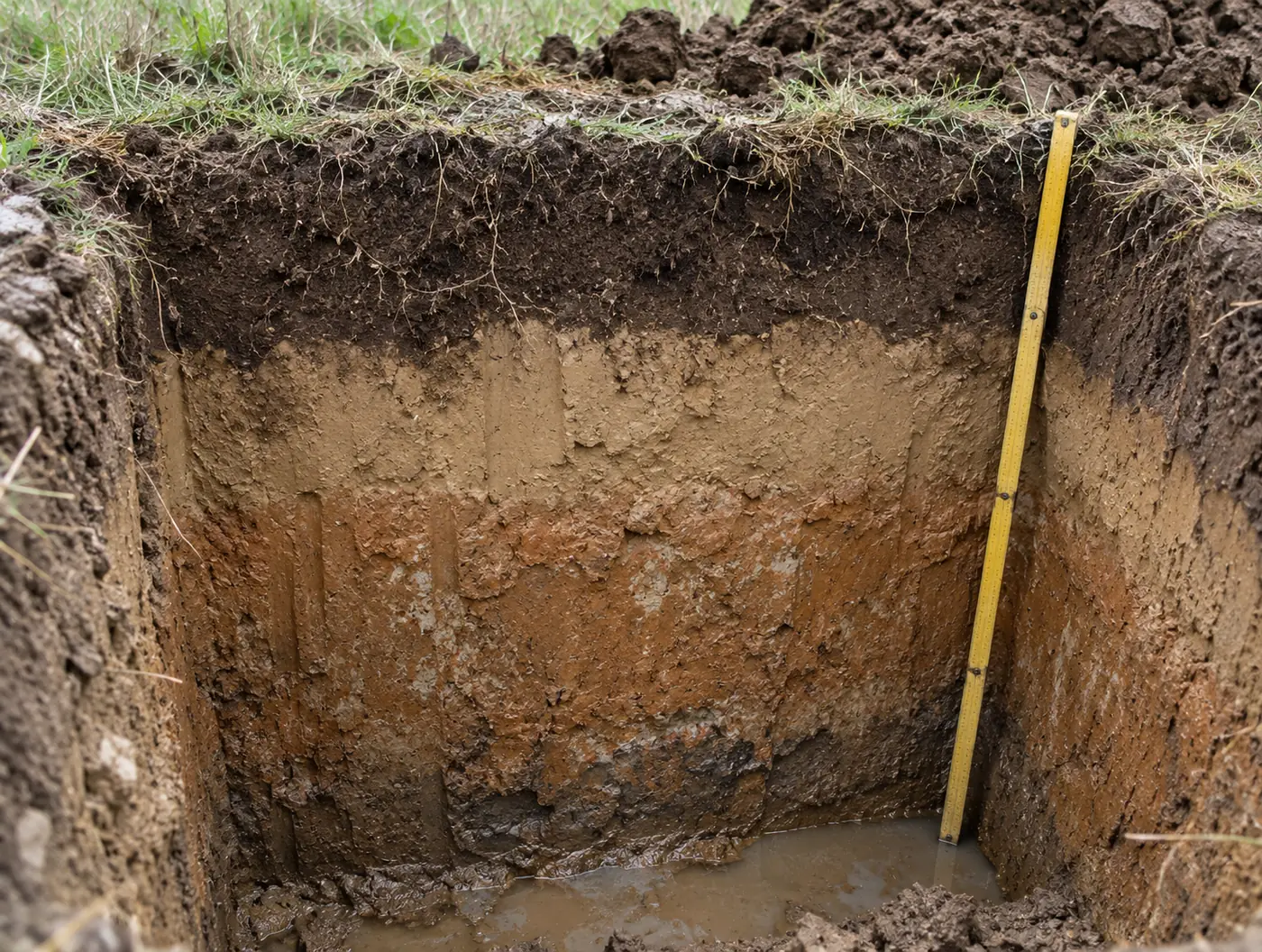
Most buyers still call it a perc test. Ohio has moved on. Under Ohio Administrative Code 3701-29-07, the governing document for a septic system is a soil evaluation performed by a certified soil evaluator who bores or digs the profile, down to as much as sixty inches, and describes what is actually there.
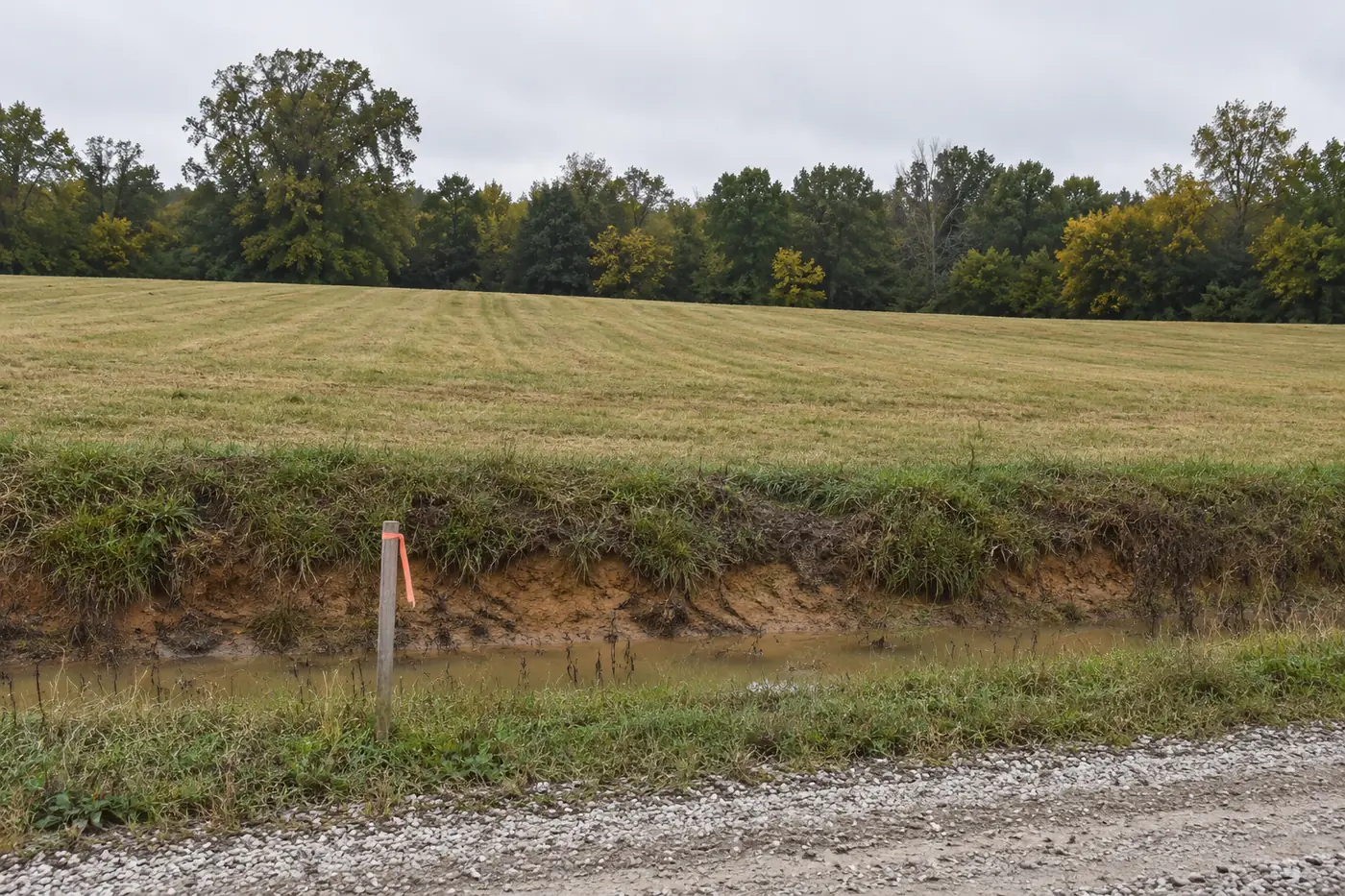
That distinction matters because of what the evaluator is looking for. In this part of Ohio the limiting factor is rarely bedrock. It is a seasonal water table perched on top of dense, slow glacial till. The three soil series you are most likely to be standing on in Warren County all carry that problem. Miamian, Ohio’s state soil, holds a perched water table roughly two and a half to three and a half feet down from January through May. Crosby and Fincastle can perch water within six inches to two feet of the surface over the same window. Brookston, which sits in the low spots, can be saturated at or above the surface.
The Ohio Department of Agriculture puts Warren, Preble, and Clinton counties in the same soil region and reports that roughly twenty-two percent of it has a seasonal high water table less than a foot down. Only about two percent has bedrock within forty inches. The problem here is water, not rock.
The exception is worth knowing about. Eldean soils, formed on limestone outwash terraces near the Little Miami and Caesar Creek, are well drained with a fast substratum. A terrace lot and a till-plain lot in the same township can behave nothing alike.
You can pull a free soil map for any parcel yourself through the USDA Web Soil Survey before you ever pay for an evaluation. It will not replace the certified evaluation, and it should not, but it will tell you whether to expect a conversation.
3. Walk the Septic Sequence With the Health District
Warren County Health District runs a specific order of operations, and skipping a step will stall you.
First the soil evaluation by a certified soil evaluator. Then a system design by a registered system designer, built around what the soil actually supports. Then a site review application, which the Health District reviews on paper and follows with an on-site visit. Only after that does a permit to install get issued, and only a registered installer can do the work, with an inspection scheduled before anything is backfilled.
Then it keeps going. New systems enter an operation and maintenance program, with a Health District inspection within the first year and another every three years after that. This is a system you will be responsible for, not a box you check at closing.
One rule is worth understanding before you fall in love with a small parcel. Ohio does not set a minimum lot size for septic. It requires sufficient suitable area for the system plus a complete replacement area. A wet or steep parcel can be large and still fail that test.
Warren County Health District’s environmental division is at 513-695-1220.
4. Confirm the Well, and Confirm It in Writing
If the parcel has no public water, the Health District issues the private water system permit before anything is drilled, and the work has to be done by a water system contractor registered with the Ohio Department of Health. After installation a sanitarian inspects, a total coliform sample is collected, and the system is shock chlorinated if there is no continuous disinfection.
Drilling depth varies across the county, so treat any number you hear secondhand as a starting point rather than a quote. What you want in writing is who pulls the permit, who drills, and who is responsible if the first hole comes up short.
5. Check the Floodplain and the Earth Disturbance Rules
Warren County spans two major watersheds, the Great Miami in the northwest corner and the Little Miami across a large share of the county. Plenty of attractive land sits near a creek.
Floodplain permitting in Warren County is administered by the Building and Zoning Department, with the county floodplain manager housed at the Soil and Water Conservation District at 513-695-3085. There is a floodplain determination request form, and it is worth filing before you buy. Note what a flood permit can cover: not only the house, but barns, sheds, fences, grading, and the septic system itself.
Separately, projects that disturb more than an acre of soil in Warren County generally require an earth disturbing permit under stormwater rules. Carlisle, Deerfield, Franklin, Lebanon, Mason, and Springboro administer their own. Warren County Soil and Water offers a free pre-project consultation at 513-695-1337.
Do These in This Order
Every one of these five checks is cheap next to a lot purchase, and every one of them is cheaper before you own the land than after. A soil evaluation that comes back badly is disappointing in September and expensive in April.
If you want the longer version, ACE’s Build-on-Lot Readiness Guide turns this into a seventeen-item checklist you can work through item by item, and the Ohio Custom Home Buyer’s Guide picks up where the land questions end.
It is also why ACE evaluates a site before setting a budget rather than after. A builder who hands you a number before walking your land is either guessing or low-balling, and you tend to find out which one somewhere around month four.
The Five-Point Lot Check
Every one of these is cheap next to a lot purchase, and every one is cheaper before you own the land than after.
- 1Confirm which office issues your permitBuilding and zoning are often two separate desks, and around Lebanon they are two separate governments. Get both answers, for your exact parcel, before you make an offer.Warren County Building & Zoning · 513-695-1290
- 2Order a soil evaluation, not a perc testOhio runs on a soil evaluation by a certified soil evaluator under OAC 3701-29-07. Pull the free USDA Web Soil Survey map for the parcel first so you know what to expect.Start free · USDA Web Soil Survey
- 3Walk the septic sequence in orderSoil evaluation, then system design, then site review, then the permit to install — and a registered installer with an inspection before anything is backfilled. Skipping a step stalls the rest.Warren County Health District · 513-695-1220
- 4Get the well commitment in writingThe Health District permits a private water system before anyone drills. In writing: who pulls the permit, who drills, and who is responsible if the first hole comes up short.Ask before closing, not after
- 5File a floodplain determination, and check the acre ruleA flood permit can cover more than the house — barns, sheds, fences, grading, and the septic system itself. Disturbing more than an acre generally needs an earth disturbing permit.Floodplain manager 513-695-3085 · Soil & Water 513-695-1337
Common Questions About Buying a Lot in Warren County
Do I need to own land before I talk to a builder?
No, and there is a good case for talking first. ACE will walk a lot with a prospective buyer before purchase, at no cost. A thirty-minute site visit surfaces drainage, access, and soil issues that a listing photo will not.
Is a perc test still required in Ohio?
Ohio’s current household sewage rules are built around a soil evaluation by a certified soil evaluator under OAC 3701-29-07, not a percolation test. When people say perc test, this is almost always the step they mean. Ask your health district what documentation they need by name.
How do I find out whether a lot is in a floodplain?
Start with the FEMA flood maps, then file a floodplain determination request with Warren County. FEMA has had active flood-map work underway in the county, so an older map is not the last word.
What if the township and the county both have rules?
Then you satisfy both. In townships that run their own zoning, the township zoning certificate usually comes first and the county building permit second. Ask for the order in writing so nothing sits waiting on the wrong desk. ACE has been handling permitting through these offices since 1985, including building in Lebanon and Springboro.
Can ACE build on a difficult lot?
Yes. ACE builds on owner-provided lots throughout the county, and sloped, wooded, wet, and long-approach parcels are all workable. The cost is what changes, which is exactly why the evaluation comes before the budget.