Why There’s No Simple Answer — and Why You Should Be Skeptical of Anyone Who Gives You One
The most common search that brings buyers here is some version of “how much does a custom home cost in Ohio?” The honest answer: it depends on a specific set of factors that vary dramatically from project to project. Any builder who gives you a confident per-square-foot number before evaluating your land, understanding your finish priorities, and reviewing a scope isn’t giving you a budget. They’re giving you a number designed to win your attention.
That said, buyers deserve a real framework. This page gives you one — not a price guarantee, but an honest breakdown of the components that make up a custom home budget in Southwest Ohio, what drives each one, and how ACE approaches budgeting differently than most builders.
Per-square-foot figures are orientation tools, not planning numbers. A $250/sq ft figure on a 2,500 sq ft home on a sloped rural lot with a well, septic, and long driveway produces a wildly different actual cost than the same figure on a flat suburban lot with utilities at the road. Site prep alone can swing your total budget by $50,000–$150,000+.
The 5 Real Cost Components of a Custom Home in Ohio
A complete custom home budget in Southwest Ohio has five components. Most builders only quote you the third one.
What Drives Your Custom Home Cost Up or Down
Understanding what moves the number — and what doesn’t — helps you make smarter decisions about where to invest and where to pull back.
| Cost Driver | Impact | Notes |
|---|---|---|
| Square footage | Very High | The single biggest driver. Every square foot added to the plan adds framing, mechanical, drywall, flooring, and finish scope. |
| Foundation type | High | Full basement adds square footage at lower cost per sq ft than above-grade additions, but adds excavation cost. Slab vs. crawl vs. full basement each have different cost profiles. |
| Stories | High | Two-story homes cost less per sq ft than single-story for equivalent square footage, because foundation and roof footprint is smaller. |
| Site conditions & prep | Very High | Rural lots, sloped sites, wooded sites, well and septic, and long driveways can add $50K–$150K+. Requires site evaluation before budgeting. |
| Roof complexity | Moderate | Simple gable roofs cost significantly less than complex hip-and-valley rooflines. Complexity also affects framing labor and material quantities. |
| Kitchen & bath scope | High | Kitchen and bath finish levels have a large per-room cost range. A basic vs. premium kitchen in the same footprint can differ by $40,000–$80,000+. |
| Exterior finish | Moderate | Brick and stone cost more than fiber cement or vinyl. Stone accents and board-and-batten add cost but can be scoped carefully. |
| Mechanical systems | Moderate | Geothermal HVAC, tankless water heating, smart home integration, and generator systems each add to scope. |
| Interior paint | Low | Negligible cost difference between colors. Paint is one of the cheapest things to change before or after move-in. |
| Hardware & fixtures | Low–Mod | Worth spending on — you touch them every day for 20 years. Within a reasonable range, selections don’t move the total budget dramatically. |
Reduce square footage rather than finish quality. A smaller, beautifully finished home is a better investment than a larger, poorly finished one. Every square foot added to the plan adds cost throughout — frame, mechanical, drywall, flooring, trim. Fewer well-designed square feet outperform more mediocre ones.
Site Preparation: The Hidden Variable That Surprises Most Buyers
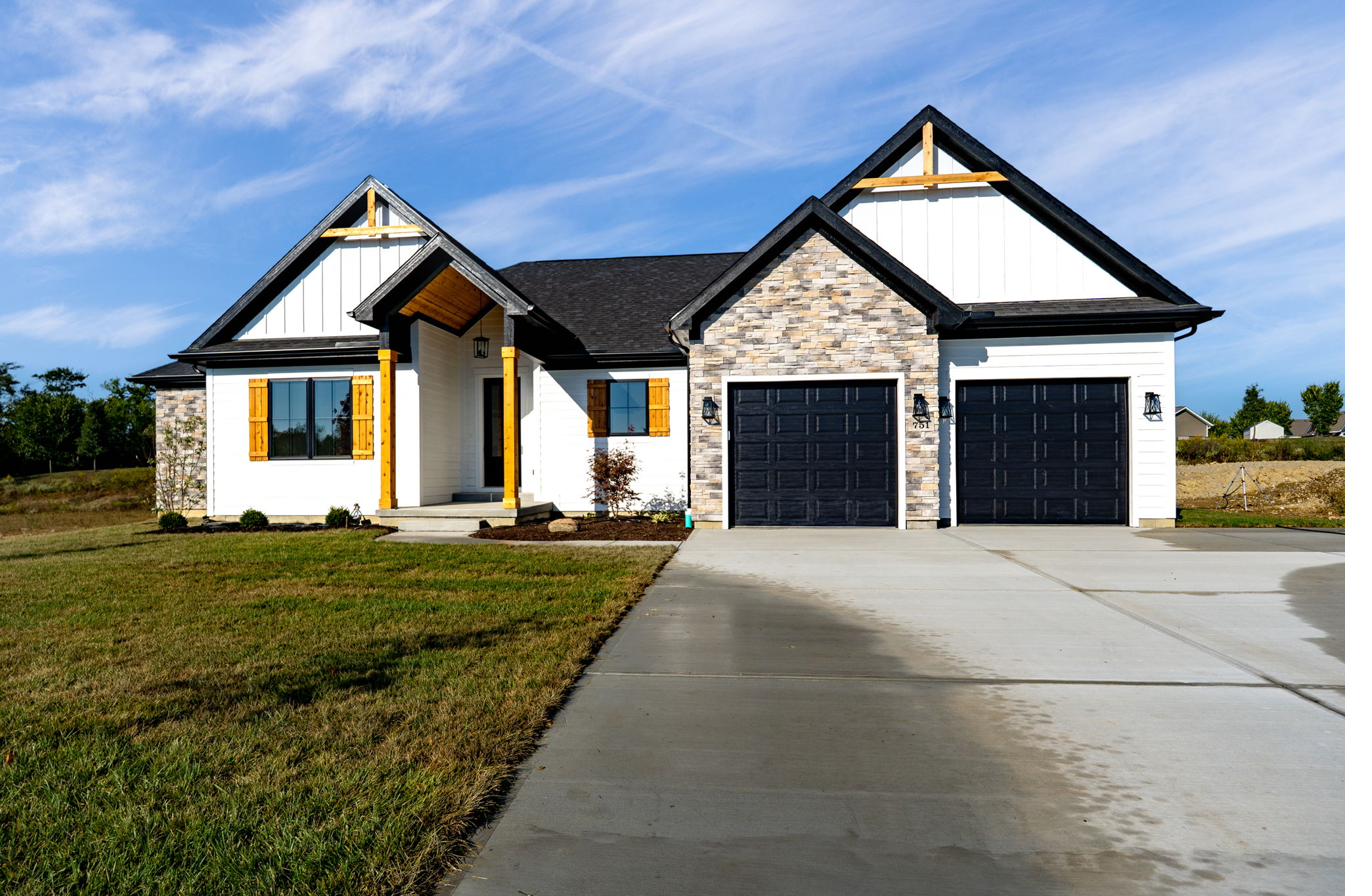
Site preparation is the most commonly underestimated cost component in custom home building. Here’s what contributes to site prep cost in Southwest Ohio:
- Clearing and grading: Wooded lots require tree removal and stump grinding. Sloped lots require cut-and-fill grading. Both add cost before a foundation is poured.
- Driveway construction: A 300-foot gravel approach costs very differently from a 1,000-foot paved driveway with a culvert crossing. Rural lots in Clinton and Preble counties often have long approaches.
- Utility connections: Electric, gas, water, and sewer runs from the road are priced by distance. A lot with utilities at the curb costs much less to connect than one requiring extended runs.
- Well and septic: Rural lots not served by municipal systems require a well and septic. A complete well-and-septic package in Southwest Ohio typically runs $20,000–$50,000+, depending on soil conditions and depth.
- Foundation preparation: Unstable soil, high water table, or rock may require engineered foundation solutions that add cost beyond a standard poured wall.
ACE evaluates every site before setting a budget — not after you’ve already signed a contract. We assess soil, drainage, utility access, driveway requirements, and lot prep before any number is finalized. A builder who quotes before seeing your land is either guessing or low-balling.
How to Get a Real Number for Your Specific Project
Per-square-foot ranges and online calculators are useful for setting general expectations. They’re not useful for budgeting a specific project on a specific site. Here’s how to get to a real number:
- Talk to a builder before you buy land. A 30-minute conversation before you close on a lot can identify site conditions that affect your budget significantly. ACE offers this conversation at no cost.
- Get a perc test on rural lots. A soil percolation test ($300–$600) tells you whether a conventional septic will work or whether you need a more expensive engineered system. Do this before you buy.
- Ask for itemized site work in any budget. Site preparation should be broken out separately — not bundled into a contingency. You need to know what clearing, driveway, and utility connections cost.
- Ask what allowances actually buy. Walk through each allowance category and ask what that dollar amount buys in today’s market at your finish level. Vague answers mean placeholder numbers.
- Budget all five components. Land, site prep, construction, soft costs, and contingency. Buyers who plan only for construction cost are regularly surprised by everything else.
The most useful thing ACE can do is walk your specific lot and have a direct, honest conversation about what your project will cost — tied to your land, your vision, and your finish priorities. That conversation is free, requires no commitment, and is the only way to get a number you can actually plan around.